A comparative evaluation of integrated and standalone apex locators under irrigated canal conditions
Accuracy of Apex Locator Integrated Endomotors in Estimating Working Length in the Presence of Endodontic Irrigants: An Ex Vivo Study
Kavalipurapu Venkata Teja¹ | Kaligotla Apoorva Vasundhara² | Pradeep Solete³ | Giampiero Rossi-Fedele⁴

Abstract
Accurate working length determination is crucial for root canal treatment. This ex vivo study evaluated the accuracy of a standalone apex locator (Root ZX Mini) and two integrated apex locator–endomotors (EnDrive and X-Smart Pro+) under different intracanal conditions. Seventy-two extracted single-rooted mandibular premolars were decoronated and standardised. The actual canal length (AML) was determined microscopically, and electronic working lengths (EWL) obtained. Measurements were taken after canal patency and drying with paper points or following irrigation with saline, sodium hypochlorite, or ethylenediaminetetraacetic acid. All devices and intracanal conditions exhibited negative deviations, with EWLs shorter than AML, ranging from −0.15 to −0.50 mm, thus remaining within clinically acceptable limits. Significant differences were observed among devices and canal contents (p < 0.05), with EnDrive showing the least deviation, particularly in the presence of sodium hypochlorite. These findings support the reliability of integrated apex locator–endomotors, though measurement accuracy may be affected by irrigant type.

1 | Introduction
Accurate determination of the root canal termination point is a critical aspect of root canal treatment. Previous research has aimed to define the precise location for the termination of root canal obturation, with root canal fillings positioned within 2 mm of the radiographic apex being associated with improved clinical outcomes [1]. Various techniques are used for working length determination. Among these, electronic apex locators (EALs) and cone-beam computed tomography have emerged as reliable aids for this purpose [2]. While intraoral periapical radiographs are commonly used to determine working length, errors, particularly the overestimation of the optimal termination point, are frequent [3]. This overestimation occurs due to deviations in the terminal location of the apical foramen [4]. Therefore, intraoral periapical radiographs should be considered adjuncts for confirmation rather than the primary method of working length determination.
In clinical practice, apex locators are frequently used for working length estimation [5]. Recent advancements have integrated apex locators into endomotors, enabling continuous working length measurement throughout the chemomechanical root canal preparation process [6]. These devices typically incorporate an auto-stop or auto-reverse mechanism to signal to the clinician when the file reaches the clinical apical termination point [7]. These devices are primarily designed to detect the apical constriction, which is regarded as the ideal anatomical landmark for determining the working length. While systematic reviews have reiterated the effectiveness of apex locators for this purpose [8–10], studies evaluating the performance of apex locator integrated endomotors remain limited [11]. Overall, integrated devices serve as reliable aids in working length estimation, though their performance may vary [11].
The primary advantage of using an apex locator integrated endomotor is its ability to provide continuous and consistent working length checks throughout the shaping process [12]. Procedures such as coronal flaring [13], glide path creation, and final shaping [14] can lead to fluctuations in the canal length, potentially leading to loss of the tentative length. Such variations can result in inefficient debridement when underestimated [15] and may cause damage to the apical terminus and periapical tissues in cases of overestimation [16]. Consequently, regular checks of the working length during chemomechanical preparation are desirable. Apex locator integrated endomotors aim to offer the advantage of continuous length maintenance, reducing procedural errors and minimising the need for multiple radiographs.
There is a paucity of evidence evaluating apex locator integrated endomotors. In the present study, the EnDrive (Advanced Technology Research (ATR) Srl, Pistoia, Italy) and X-Smart Pro+ (Dentsply Sirona, Balligues, Switzerland) were used as experimental devices to assess their efficacy in determining the working length. The EnDrive, a newly developed integrated endomotor with an apex locator, was recently launched by Komet Dental (GEBR. Brasseler GmbH & Co. KG, Lemgo, Germany) in Europe. This device features an integrated endomotor and apex locator that determines working length by analysing impedance changes generated by dual-frequency sinusoidal and pseudo-sinusoidal waveforms, as described in patent WO2010073205A1. The X-Smart Pro+, another experimental device in this study, utilises dynamic technology to facilitate real-time length measurement during root canal shaping. The Root ZX Mini was used as the comparison group, as it has a well-established track record for accurate working length estimation [17].
Electronic apex locators estimate the working length by measuring electrical impedance, which refers to the opposition to alternating current. This measurement occurs between a file inserted into the canal and an external electrode. As the file approaches the apical region, impedance changes due to variations in surrounding tissues and canal contents, allowing the device to determine the position of the file tip within the canal.
The Root ZX Mini (J. Morita, Tokyo, Japan) is a third-generation standalone apex locator that operates on a dual-frequency impedance ratio principle. It simultaneously measures impedance at 8 and 0.4 kHz and calculates the ratio of these values. When the ratio reaches a defined threshold (approximately 0.67), the device identifies the file tip as being at the apical constriction. The EnDrive (ATR Srl, Pistoia, Italy) is an integrated endomotor with a built-in apex locator. It determines the working length using two sinusoidal waves at different frequencies and one pseudo-sinusoidal wave. The difference in amplitude between these signals correlates with the impedance of the canal, enabling precise estimation of file position, as described in patent WO2010073205A1. The X-Smart Pro+ (Dentsply Sirona) employs continuous impedance monitoring during active file rotation or reciprocation. Through its Dynamic Accuracy system, it tracks impedance changes in real time, compares these values against internal reference thresholds, and automatically halts the motor when the pre-set apical position is reached.
Intracanal contents may affect the efficacy of working length determination using electronic apex locators. Previous research has demonstrated the effectiveness of electronic apex locators when used in dry canals [18]. However, variations in working length measurements can occur when irrigating solutions are present [19]. Electroconductive solutions, such as sodium hypochlorite (NaOCl), are commonly used during chemomechanical preparation for effective debridement and lubrication and may interfere with apex locator readings [19]. While the impact of other irrigant solutions may be less significant (ethylene diamine tetraacetic acid or saline solution) [20], the presence of electroconductive solutions can lead to impedance variations, affecting the accuracy of working length measurements. This is particularly relevant for integrated endomotors, which must maintain accuracy in the presence of such solutions during root canal preparation.
Therefore, this study aims to evaluate, ex vivo, the accuracy of two integrated endomotors (EnDrive and X-Smart Pro+) and a standalone apex locator (Root ZX Mini) in estimating working length under different intracanal conditions, namely dry, with NaOCl, saline, or EDTA. The null hypothesis is that there is no significant difference in the working length estimations made by the integrated endomotors and the standalone apex locator when used with various intracanal contents (dry, NaOCl, EDTA, or saline).
2 | Materials and Methods
Prior institutional human ethics committee approval was obtained from a university-affiliated hospital (IHEC/SDC/FACULTY/21/ENDO/137). The PRILE guidelines were followed for the design and reporting of the present study [21]. The sample size was estimated a priori based on results from a comparable study [12]. A sample size of 21 per group was determined, achieving a power of 95% (1—β = 95%, α = 0.05) and an effect size of 1.05. To accommodate potential sample loss, three samples were added to each group, resulting in a final sample size of 72.
Mandibular first or second premolars recently extracted for orthodontic reasons from patients aged 18–25, with a single root and a single root canal, were included in the study. Immediately after extraction, the external surface of each tooth was curetted to remove soft tissue debris and stored in a phosphate-buffered saline solution. Only fully matured, single-rooted premolars with a single canal were selected. Teeth with minimal curvatures (≤10°) were considered. Teeth with developmental defects, extensive caries, severe curvatures, root fractures, or resorptions were excluded from the study.
The extracted teeth were evaluated for their morphology by obtaining intraoral periapical radiographs at various angulations. Once the specimens were confirmed, the samples were decoronated at the level of the cemento–enamel junction to create a flat occlusal reference point, ensuring reproducibility and standardising the overall tooth length to 17 mm. The decoronated occlusal surface served as the consistent reference point for all subsequent measurements. Both operators used this standardised surface to adjust the rubber stop position during canal length determination and EWL recording. Subsequently, the samples were accessed using a round diamond bur (Komet Dental). A carbide safe-ended bur (Komet Dental) was then used to refine the access. Following this, patency was confirmed using a stainless steel #10, 25 mm K-file (Dentsply Maillefer) in a watch-winding motion.
During the patency check, the canals were irrigated with 5 mL of 5.25% sodium hypochlorite (CanalPro, ColteneWhaledent PVT Ltd., India) using a 31-gauge, single-side vented needle (Komet Dental), followed by 5 mL of normal saline and paper point drying. A 25 mm, #15 stainless steel hand K-file (Dentsply) was used for canal gauging and to assist in determining the AML, which was subsequently confirmed under 20× magnification using a stereo microscope (Leica M205 C, Leica Microsystems GmbH, Wetzlar, Germany). Only teeth whose canal width near the terminus was approximately compatible with an ISO #15 K-file were included based on gauging. The patency check and canal length determination procedures were carried out by an endodontist (PS).
Canal length determination was performed under a stereo microscope (Leica M205 C, Leica Microsystems GmbH, Wetzlar, Germany) connected to a digital camera at 20× magnification. The AML was recorded when the hand K-file was visualised at the apical foramen under the stereo microscope. The obtained definitive microscopic lengths (AML) were recorded using a digital calliper (Simhevn Electronic Digital Calliper, Shenzhen, Huiyi Trading Co. Ltd., Shenzhen, China).
The remaining experiments were conducted by another endodontist (KVT), who was blinded to the actual microscopic lengths (AMLs) and subgroup allocations but was necessarily aware of the device-specific protocols required for each experimental group. Prior to allocation, specimens were placed in a container filled with alginate, exposing 5 mm of the coronal root surface, and the circuit was closed by placing them in the alginate. The samples were randomly divided into three groups based on the device used: Group—Electronic apex locator (n = 24), Group—EnDrive integrated endomotor (n = 24), and Group—X-Smart Pro+ integrated endomotor (n = 24). Each group was further subdivided into four subgroups according to the intracanal contents: Paper-dry (n = 18); Normal saline solution (JoinHub Pharma, Ahmedabad, Gujarat, India) (n = 18); 5.25% NaOCl solution (CanalPro, ColteneWhaledent PVT Ltd., India) (n = 18); and 17% EDTA solution (MD Cleanser, Meta Biomed Europe GmbH, Mülheim, North Rhine-Westphalia, Germany) (n = 18).
This grouping approach was chosen to avoid the cross-use of devices on the same specimens, as each system required different instrumentation protocols. Using multiple devices on a single tooth could have altered the canal anatomy and affected measurement accuracy. Assigning one device per group helped ensure consistency and preserve the integrity of canal conditions. A computer-generated random sequence was used for allocation. To maintain allocation concealment, specimen coding and assignment were performed independently by an individual not involved in data collection or analysis. The second operator (KVT), who conducted the experimental procedures and electronic working length (EWL) measurements, was blinded to both the subgroup allocations and the actual microscopic lengths (AMLs) of the specimens.
2.1 | Group: Electronic Apex Locator
EWL measurements in this group were performed using a standalone apex locator (Root ZX Mini, J. Morita Corp., Tokyo, Japan) according to the manufacturer’s instructions (Figure 1). A 25 mm, #15 hand K-file was inserted in a watch-winding motion until the apex locator reading reached the green flashing bar. The readings were considered valid only when they remained stable for at least five seconds. The measurements were then recorded using the digital calliper. To maintain consistency across groups, the file was not deliberately extended 0.5 mm beyond the apex, as this was not feasible with the rotary glide path file used in the integrated endomotor groups, where working length determination was based on the auto-stop signal provided by the device.
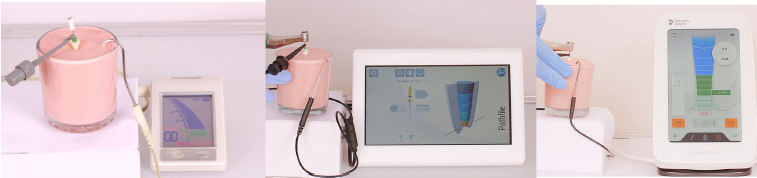
FIGURE 1 | Representative devices used for root canal length determination in a simulated root canal model. (Left) Standalone electronic apex locator (Root ZX Mini, J Morita Corp.) displaying real-time apex position feedback. (Centre) Endodontic motor with integrated apex locator (EnDrive, Komet Dental). (Right) Endodontic motor with integrated apex locator (X-Smart Pro+, Dentsply Sirona). All systems provide continuous electronic feedback during canal instrumentation.
2.2 | Groups: EnDrive Integrated Endomotor and X-Smart Pro+ Integrated Endomotor
EWL measurements in this group were carried out using the relevant integrated endomotor according to the manufacturer’s instructions. Measurements were made with a 25 mm rotary glide path file (PathFile White, ProGlider, Dentsply Maillefer). The glide path was performed at the manufacturer-recommended speed and torque (300 RPM, 2.0 Ncm). The auto-stop function was enabled during the glide path procedure. Once the recommended torque and speed were set, the rotary glide path file was connected to the contra-angled handpiece and gradually advanced into the canal under light pressure until the integrated apex locator, using impedance feedback, identified when the file tip reached the predetermined apical threshold. For both the integrated endomotors, this threshold corresponds to the apical constriction, which is the standard anatomical reference for working length determination. At this point the motor halted automatically and remained stationary until manually restarted by the operator, as per the manufacturer’s design. Afterward, the rubber stop was adjusted, and the file was removed. The values were then recorded using a digital calliper. All working length measurements using the apex locator devices and digital calliper were performed in triplicate, and the mean of the three readings was used for analysis.
Subgroup intracanal contents were as follows:
Paper Dry: After initial patency, the canals were dried with 15 #0.02 paper points. The final paper point was inspected visually to ensure it appeared dry before proceeding with the working length determination.
Normal Saline Solution, 5.25% NaOCl, and 17% EDTA subgroups: After initial patency, the canals were irrigated with 5 mL of the relevant irrigant solution using a 31-gauge, side-vented needle, with the needle placed as apically as possible without binding. The tooth surface was wiped with a cotton pellet before proceeding with the working length determination.
After all experimental procedures, the differences between the AML and the EWL for each experimental device were calculated. The reference value was set to zero when the AML and EWL coincided. Positive values were recorded when the EWL exceeded the AML, whereas negative values were recorded when the EWL was shorter than the AML. The difference values were then tabulated and analysed statistically across the different groups and subgroups.
3 | Statistical Analysis
Statistical analyses were performed using a one-way analysis of variance (ANOVA) to compare the accuracy of different electronic apex locators across experimental conditions. Post hoc comparisons were conducted using Tukey’s Honestly Significant Difference (HSD) test to identify statistically significant differences between subgroups. Data were expressed as the mean ± standard deviation (SD). A significance level of p < 0.05 was considered statistically significant. All statistical analyses were performed using SPSS (IBM Corp., Armonk, NY, USA).
4 | Results
4.1 | Inter-Device Comparison Under Various Canal Conditions
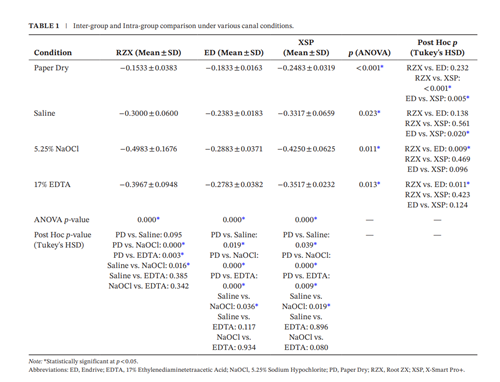
Table 1 summarises the mean EWL deviations for the three apex locators under four canal conditions. A one-way ANOVA revealed a significant overall difference (p < 0.001). Pairwise Tukey’s post hoc analysis demonstrated that the deviation observed with X-Smart Pro+ was significantly greater than that with Root ZX (p < 0.001) and Endrive Komet (p = 0.005), with no further significant differences present between Root ZX and Endrive Komet under dry conditions.
Under saline irrigation, although the overall difference was significant, only the comparison between Endrive and X-Smart Pro+ reached statistical significance (p = 0.020), where the Endrive had a lower mean discrepancy from AML than X-Smart Pro+. When canals were irrigated with 5.25% NaOCl, ANOVA confirmed a significant difference among devices (p = 0.011), and Tukey’s test indicated a significant difference between Root ZX and Endrive (p = 0.009), with Endrive demonstrating greater accuracy than Root ZX under these conditions. No further significant differences were found between the devices tested under 5.25% NaOCl. For canals irrigated with 17% EDTA, the overall ANOVA was significant, and pairwise comparisons revealed a significant difference between Root ZX and Endrive (p = 0.011), with Endrive exhibiting less deviation from AML than Root ZX. No further significant differences were found between the devices tested under 17% EDTA.
4.2 | Intra-Device Comparison Across Various Canal Conditions
Table 1 presents the within-device comparison of EWL measurements across the four canal conditions for each tested device. For the Root ZX device, ANOVA indicated a highly significant difference among conditions (p = 0.000). Tukey’s post hoc comparisons showed that the deviation in the NaOCl condition was significantly greater than in the paper-dry (p < 0.001) and EDTA (p = 0.003) conditions, with a significant difference also noted between the saline and NaOCl conditions (p = 0.016). This suggests that Root ZX performed most accurately in paper-dry and EDTA conditions. No further significant differences were found when comparing intracanal conditions.
For the Endrive device, significant differences were also observed among irrigant conditions (ANOVA, p = 0.000). Specifically, the paper-dry canal differed significantly from saline (p = 0.019), NaOCl (p = 0.000), and EDTA (p = 0.000), while a significant difference was seen between saline and NaOCl (p = 0.036). Endrive showed the least deviation in the paper-dry condition. No further significant differences were found when comparing subgroups.
Similarly, for the X-Smart Pro+ device, ANOVA revealed significant differences across conditions (p = 0.000). Post hoc analysis indicated that the paper-dry condition differed significantly from saline (p = 0.039), NaOCl (p = 0.000), and EDTA (p = 0.009), with an additional significant difference between saline and NaOCl (p = 0.019). The results suggest that X-Smart Pro+ demonstrated the highest accuracy in the paper-dry condition. No further significant differences were found when comparing subgroups.
5 | Discussion
Within the limitations of the present laboratory study, canal conditions significantly influenced EWL measurements, with NaOCl irrigation causing the greatest deviations, particularly for the Root ZX Mini. Among the tested devices, Endrive consistently exhibited superior accuracy across most conditions, while the apex locator integrated X-Smart Pro+ showed greater variability, especially under dry and saline conditions. Thus, the null hypothesis was partially rejected.
The results align with previous studies that assessed the efficacy of various electronic apex locators in the presence of irrigant solutions [19], which also reported that NaOCl affected measurement accuracy and that standalone apex locators generally demonstrated reduced reliability under such conditions. Although previous studies evaluating the efficacy of integrated apex locators under various root canal irrigants indicated their accuracy, the evidence remains limited [19].
A key finding of this study was the significantly lower EWL deviations recorded by the Endrive device across various canal conditions, particularly under NaOCl and EDTA irrigation. This supports the hypothesis that certain apex locator technologies may maintain greater consistency in working length determination, even in the presence of conductive irrigants that typically compromise measurement accuracy. While the Endrive demonstrated more stable performance, variations in EWL measurements were still observed, reinforcing the notion that irrigant properties can influence electronic readings. As no prior studies have specifically evaluated the Endrive, this study provides preliminary insights into its clinical potential.
Differences observed in comparison to previous studies with different integrated devices [11] may be attributed to variations in methodology, including sample size, canal anatomy, irrigant protocol, and measurement techniques.
The superior performance of the Endrive device under irrigated conditions may be partly explained by its multi-frequency sinusoidal measurement method, as described in patent WO2010073205A1. The system generates two sinusoidal waves at different frequencies along with one pseudo-sinusoidal wave, and the difference in amplitudes between these signals is proportional to the canal’s impedance. This design allows the device to monitor changes in impedance as the file approaches the apex and may provide enhanced stability in conductive environments such as NaOCl or EDTA. While this could explain the lower variability observed in this study, detailed validation data on the specific measurement algorithm remain limited; further investigation is needed to confirm whether this technology accounts for Endrive’s performance advantage.
Another notable observation was the pronounced variability in EWL measurements recorded with both the X-Smart Pro+ and Root ZX Mini devices, particularly using NaOCl and EDTA irrigation. However, the significance of these differences warrants careful interpretation, as post hoc analysis revealed no significant differences between X-Smart Pro+ and Endrive under these conditions. While significant differences were observed in EWL deviations, particularly favouring the Endrive device, these deviations still fell within the generally accepted ±0.5 mm clinical threshold. Therefore, numerical superiority in a laboratory setting may not always equate to clinically meaningful differences.
To ensure optimal accuracy in clinical scenarios, especially when using conductive irrigants like NaOCl, clinicians are advised to verify measurements with adjunctive techniques, repeat readings when inconsistencies arise, or temporarily dry the canal before measurement.
This finding is clinically relevant because accurate and consistent working length determination is critical for enhancing root canal disinfection, ensuring that irrigants and instruments effectively reach the apical region without over- or under-instrumentation.
The role of intracanal contents in electronic working length determination requires further discussion. NaOCl was associated with the largest deviations, particularly affecting the Root ZX Mini device, while the Endrive demonstrated consistently lower deviations across all tested conditions. These findings highlight the importance of irrigant selection when using EAL-based systems, especially integrated endomotors, and suggest that clinicians should be mindful of potential measurement variability and consider confirming working length radiographically or with multiple readings when using certain irrigants.
In the presence of inconsistent readings, operators may consider drying the canal before repeating the measurements. However, clinicians should exercise caution when introducing files into completely dry canals, as the absence of fluid may increase the risk of blockages, apical extrusion, file separation, or inaccurate readings due to reduced electrical conductivity.
The direction and entity of the deviations reported in laboratory studies need further reflection, as these may have limited clinical significance. Unlike many clinical studies that report mostly negative working length deviations along with a few positive values, typically within ±0.5 mm [8, 19, 22], the results of the present study were exclusively negative and consistently short of the apical constriction.
The findings align with a recently published in vitro study that evaluated an integrated endomotor under both rotary and reciprocating kinematics, which also reported exclusively negative readings [12]. However, no previous study has specifically investigated the laboratory assessment of the accuracy of integrated endomotors under various canal conditions using the devices examined in the present study.
Owing to the scarcity of research on this topic and the limited available data on recently released integrated apex locators, direct comparison of the findings of the present study is haphazard [11]. Certain previously published ex vivo studies also demonstrated a similar trend of exclusively shorter or negative recorded values with Root ZX in extracted specimens with intact apices under conventional irrigants in laboratory settings [23–25].
Upon critical appraisal of the methodology, it is worth noting that alginate is widely regarded as a stable and reproducible embedding medium and often shows no significant difference from actual canal lengths in ex vivo models [26]. However, it has electroconductive properties that do not perfectly replicate the complex impedance of the periodontal ligament [27–29]. Even minor conductivity mismatches can shift the apex locator’s zero point coronally, resulting in uniformly shorter readings compared with true in vivo conditions.
Compared to the periodontal ligament, alginate presents a relatively uniform and constant impedance, lacking the biologic variability and dynamic moisture balance of natural periapical tissues. The periodontal ligament provides a more complex and heterogeneous conductive interface that interacts with apex locator signals in a manner not fully replicated by synthetic media. This difference can lead to a coronally shifted zero point in alginate-embedded samples, even when embedding and calibration protocols are rigorously followed.
Although alginate is considered an acceptable and reproducible medium in ex vivo studies, its inability to mimic the vascular, cellular, and collagenous nature of in vivo tissues may account for systematic underestimation of working length values. These inherent differences underscore the need for cautious extrapolation of ex vivo EAL results to clinical scenarios and further emphasise the importance of complementary clinical verification methods during working length determination.
Secondly, although the AML was determined under 20× magnification prior to electronic measurements, the operator who performed the EAL assessments was blinded to those values and based working length determinations exclusively on the apex locator’s real-time signals, without direct visual confirmation of the apical foramen. The file’s rubber stop position was measured with a digital calliper to record the EWL. In accordance with standard apex locator protocols, instrumentation was terminated upon the initial device-indicated signal, as suggested by the manufacturer, without further advancement. This conservative approach, aimed at minimising the risk of over-instrumentation, may have contributed to the consistently negative deviations observed in electronic working length measurements.
Thirdly, since device measurement relies on internal impedance standards, discrepancies in canal conductivity between dry and irrigated conditions may introduce theoretical offsets. To minimise variability, each tooth was embedded in freshly mixed alginate immediately before measurement, and device functionality was verified prior to each use using manufacturer-prescribed start-up procedures. This reduced the risk of conductivity changes or calibration mismatches influencing measurements. The strict inclusion criteria, the decoronation of teeth [2], and the involvement of a single experienced operator might have supported a more precise estimation, potentially deviating from clinical relevance.
It is important to highlight that in this study, the files were not intentionally extruded beyond the apical foramen during EWL measurements. While this conservative approach aligns with clinical safety protocols and manufacturer recommendations, it may have contributed to the uniformly negative deviations observed. This is particularly relevant in cases where the apical anatomy does not conform to the traditional presence of a distinct apical constriction. Teeth exhibiting a single apical constriction or a non-classical taper may present altered impedance profiles, potentially causing the apex locator to register an endpoint coronal to the actual apical foramen.
Such anatomical variability, coupled with the non-extrusion protocol, could explain the tendency for underestimation in EWL measurements. This highlights the importance of considering apical morphology when interpreting apex locator readings and supports the clinical practice of verifying electronic measurements with additional techniques, especially in anatomically variable cases.
A key strength of this investigation lies in its comparative design, which evaluated traditional EALs and integrated endomotors across a range of irrigant conditions. This approach mirrors real-world clinical scenarios and provides a more comprehensive, laboratory-based understanding of device performance. The inclusion of commonly used irrigants further enhances the clinical applicability of the results. Additionally, the study employed a standardised and reproducible methodology [2], including consistent canal preparation and microscopic length verification, to minimise experimental bias and ensure accuracy in measurement comparisons.
Despite these strengths, the study has limitations. As an ex vivo experiment, it may not fully reflect in vivo complexities, such as tissue remnants, bleeding, canal curvature, apical morphology, or resorptive defects, all of which can influence EWL readings. Although the teeth were recently extracted from young adult patients, the pulpal status was not histologically confirmed. As mechanical instrumentation was intentionally avoided to preserve canal anatomy, residual pulp tissue may have remained in some canals despite NaOCl irrigation, which could have influenced apex locator readings.
Moreover, while the study focused on three specific devices, variations in technology, calibration, and firmware across different brands may limit the generalisability of the findings. Further studies should aim to validate these results in vivo, where patient-specific factors and operator techniques could provide additional insights into device performance.
Comparative evaluations of a broader range of apex locators and integrated systems under identical conditions would help establish more generalisable performance benchmarks. Investigations correlating working length accuracy with long-term clinical and patient-reported outcomes, such as postoperative pain, healing of apical periodontitis, and tooth survival, are also warranted to fully understand the clinical implications of EWL deviations across different devices and irrigant conditions.
6 | Conclusion
Within the limitations of this ex vivo study, all tested apex locator integrated endomotors demonstrated comparable accuracy in working length determination across different irrigating conditions. NaOCl was associated with reduced accuracy, whereas dry canals yielded more precise readings.

Authors
¹ Department of Conservative Dentistry and Endodontics, Mamata Institute of Dental Sciences, Hyderabad, Telangana, India
² Department of Prosthodontics, Saveetha Dental College and Hospitals, Saveetha Institute of Medical and Technical Sciences, Saveetha University, Chennai, Tamil Nadu, India
³ Department of Conservative Dentistry and Endodontics, Saveetha Dental College and Hospitals, Saveetha Institute of Medical and Technical Sciences, Saveetha University, Chennai, Tamil Nadu, India
⁴ Adelaide Dental School, the University of Adelaide, Adelaide, South Australia, Australia
Correspondence: Giampiero Rossi-Fedele (giampiero.rossi-fedele@adelaide.edu.au)
Received: 16 May 2025
Revised: 24 July 2025
Accepted: 31 July 2025
Funding: This work was supported by GEBR. Brasseler GmbH & Co. KG, Trophagener Weg 25, 32657 Lemgo, Germany.
Keywords: electronic apex locator | endodontics | integrated endomotor | sodium hypochlorite | working length determination
References
-
Y. L. Ng, V. Mann, S. Rahbaran, J. Lewsey, and K. Gulabivala, “Outcome of Primary Root Canal Treatment: Systematic Review of the Literature – Part 2. Influence of Clinical Factors,” International Endodontic Journal 41 (2008): 6–31.
-
A. ElAyouti, T. Connert, P. Dummer, and C. Löst, “A Critical Analysis of Research Methods and Experimental Models to Study Working Length Determination and the Performance of Apex Locators – A Narrative Review With Recommendations for the Future,” International Endodontic Journal 55 (2022): 281–294.
-
B. M. Faraj, “Preoperative Estimation of Endodontic Working Length With Cone-Beam Computed Tomography and Standardized Paralleling Technique in Comparison to Its Real Length,” BioMed Research International 2020 (2020): 7890127.
-
M. Z. Manva, R. Alroomy, S. Sheereen, M. K. Hans, and S. K. Mallineni, “Location and Shape of the Apical Foramina in Posterior Teeth: An In Vitro Analysis,” Surgical and Radiologic Anatomy 43 (2021): 275–281.
-
S. Kaşıkçı, S. K. Özbek, E. Şirinoğlu, and O. Özdemir, “Clinicians' Perspectives, Inducements, Preferences, and Clinical Experiences Regarding the Use of Electronic Apex Locator and Apex Locator Integrated Engine-Driven Instrumentation: A Cross-Sectional Study,” BMC Oral Health 24 (2024): 939.
-
B. C. Vasconcelos, L. M. Bastos, A. S. Oliveira, et al., “Changes in Root Canal Length Determined During Mechanical Preparation Stages and Their Relationship With the Accuracy of Root ZX II,” Journal of Endodontics 42 (2016): 1683–1686.
-
A. T. G. Cruz, C. Wichnieski, E. Carneiro, U. X. da Silva Neto, G. Gambarini, and L. Piasecki, “Accuracy of 2 Endodontic Rotary Motors With Integrated Apex Locator,” Journal of Endodontics 43 (2017): 1716–1719.
-
I. Tsesis, T. Blazer, G. Ben-Izhack, et al., “The Precision of Electronic Apex Locators in Working Length Determination: A Systematic Review and Meta-Analysis of the Literature,” Journal of Endodontics 41 (2015): 1818–1823.
-
J. N. R. Martins, D. Marques, A. Mata, and J. Caramês, “Clinical Efficacy of Electronic Apex Locators: Systematic Review,” Journal of Endodontics 40 (2014): 759–777.
-
K. Nasiri and K. T. Wrbas, “Accuracy of Different Generations of Apex Locators in Determining Working Length: A Systematic Review and Meta-Analysis,” Saudi Dental Journal 34 (2022): 11–20.
-
G. R. M. La Rosa, A. Angjelova, E. Jovanova, S. Apostolska, J. M. Santos, and E. Pedullà, “Integrated Electronic Apex Locators for Determining Working Length: A Systematic Review of In Vitro Studies,” Odontology 113 (2024): 918–929. https://doi.org/10.1007/s10266-024-01039-4
-
V. de Almeida Gardelin, J. I. A. M. Vinholes, R. Grazziotin-Soares, F. G. Pappen, and F. B. Barletta, “Influence of Rotary and Reciprocating Kinematics on the Accuracy of an Integrated Apex Locator,” Australian Endodontic Journal 49 (2023): 202–208.
-
M. León-López, D. Cabanillas-Balsera, V. Areal-Quecuty, et al., “Influence of Coronal Preflaring on the Accuracy of Electronic Working Length Determination: Systematic Review and Meta-Analysis,” Journal of Clinical Medicine 10 (2021): 2760.
-
M. Alovisi, D. Mirra, E. Berutti, et al., “Working Length Variation During Multiple-Visit Endodontic Treatment: An Observational Study,” Australian Endodontic Journal 49, no. S1 (2023): 107–112.
-
R. Wigler, R. Huber, S. Lin, and A. Y. Kaufman, “Accuracy and Reliability of Working Length Determination by Gold Reciproc Motor in Reciprocating Movement,” Journal of Endodontics 40 (2014): 694–697.
-
Z. Shirazi, A. Al-Jadaa, and A. R. Saleh, “Electronic Apex Locators and Their Implications in Contemporary Clinical Practice: A Review,” Open Dentistry Journal 17 (2023): e187421062212270.
-
O. S. Alothmani, “The Accuracy of Root ZX Electronic Apex Locator,” Saudi Endodontic Journal 2 (2012): 115.
-
S. Bilaiya, P. M. Patni, P. Jain, S. H. Pandey, S. Raghuwanshi, and B. Bagulkar, “Comparative Evaluation of Accuracy of Ipex, Root ZX Mini, and Epex Pro Apex Locators in Teeth With Artificially Created Root Perforations in Presence of Various Intracanal Irrigants,” European Endodontic Journal 5 (2020): 6–9.
-
S. A. Shekarbaghani, B. Bolhari, and Z. Khalilak, “The Effect of Different Root Canal Irrigations on the Accuracy of Apex Locators: A Systematic Review,” Journal of Clinical and Experimental Dentistry 16 (2024): 1538–1546.
-
P. Jha, V. Nikhil, S. Raj, R. Ravinder, and P. Mishra, “Accuracy of Electronic Apex Locator in the Presence of Different Irrigating Solutions,” Endodontology 33 (2021): 232–236.
-
V. Nagendrababu, P. E. Murray, R. Ordinola-Zapata, et al., “PRILE 2021 Guidelines for Reporting Laboratory Studies in Endodontology: A Consensus-Based Development,” International Endodontic Journal 54 (2021): 1482–1490.
-
G. Kaur, A. R. Thomas, R. S. Samson, et al., “Efficacy of Electronic Apex Locators in Comparison With Intraoral Radiographs in Working Length Determination: A Systematic Review and Meta-Analysis,” BMC Oral Health 24 (2024): 532.
-
J. A. Kang and S. K. Kim, “Accuracies of Seven Different Apex Locators Under Various Conditions,” Oral Surgery, Oral Medicine, Oral Pathology, Oral Radiology, and Endodontology 106 (2008): 57–62.
-
Q. Baruah, N. Sinha, B. Singh, P. N. Reddy, K. Baruah, and V. Augustine, “Comparative Evaluation of Accuracy of Two Electronic Apex Locators in the Presence of Contemporary Irrigants: An In Vitro Study,” Journal of the International Society of Preventive & Community Dentistry 8 (2018): 349–353.
-
O. Khattak, E. Raidullah, and M. L. Francis, “A Comparative Assessment of the Accuracy of Electronic Apex Locator (Root ZX) in the Presence of Commonly Used Irrigating Solutions,” Journal of Clinical and Experimental Dentistry 6 (2014): 41–46.
-
A. Y. Siddiqui, “Influence of Embedding Medium on iPex Electronic Apex Locator Accuracy: An Ex Vivo Comparative Study Using Alginate, Saline, and Gelatin Models,” Journal of Contemporary Dental Practice 24 (2023): 733–738.
-
M. F. Iparraguirre Nuñovero, L. Piasecki, A. V. K. Segato, V. P. D. Westphalen, U. X. Silva Neto, and E. Carneiro, “A Laboratory Study of the Accuracy of Three Electronic Apex Locators: Influence of Embedding Media and Radiographic Assessment of the Electronic Apical Limit,” International Endodontic Journal 54 (2021): 1200–1206.
-
T. G. Wolf, A. Krauß-Mironjuk, R. J. Wierichs, and B. Briseño-Marroquín, “Influence of Embedding Media on the Accuracy of Working Length Determination by Means of Apex Locator: An Ex Vivo Study,” Scientific Reports 11 (2021): 3340.
-
J. V. Baldi, F. R. Victorino, R. A. Bernardes, et al., “Influence of Embedding Media on the Assessment of Electronic Apex Locators,” Journal of Endodontics 33 (2007): 476–479.